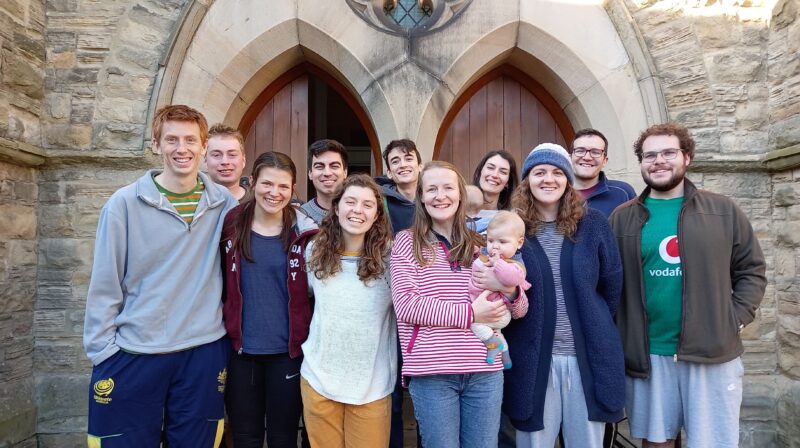
The Achor Community is a group of people from the King’s Church Durham congregation who live on the Sherburn Road Estate in Gilesgate.
The name ‘Achor’ is a reference from one of the Old Testament prophets, Hosea 2.15, where God says he will ‘make the valley of Achor a door of hope’: Achor was a word previously associated with hopelessness (see Joshua 7), but in God’s hands it becomes one of hope.
This is a reflection of the overarching story through the Bible where situations of sin, brokenness and despair are turned to joy and hope. In taking the name Achor, we express our desire for this same story to be seen many times over in our own lives and in the lives of our neighbours on the estate.
Inward and outward
A central part of Achor is that we are not just a group of Christians who happen to live in the same area, but that we have chosen to share our lives together as a missional community. This means sharing a common rhythm of life which involves an inward focus (community) and an outward focus (mission).
Inwardly, we eat a meal together each week and meet several times a week to pray for our neighbourhood – as well as being around to help and support each other and share fun times together too.
Outwardly, we are committed to serving God and serving our neighbours on the estate, by getting to know them, finding ways to invite them into our lives, and seeking to share our faith in Jesus with them.
We do this because the importance of Christians both loving one another and reaching out to the world is a clear command of Jesus. We are told repeatedly in 1 John, for example, that having love for our brothers and sisters is not an optional extra in the Christian life. It is a key mark of our faith – ‘if we love one another, God lives in us and his love is made complete in us’ (1 John 4.12). Similarly, reaching out to those around us in mission is a core part of what God wants his church to be.
Furthermore, these two sides of community and mission are not separate, but interact with each other in beautiful ways. Some of our most enduring friendships have been built in contexts like our weekly women’s breakfast group and small groups over shared food, fun, and Bible studies. As well as sharing about who God is and what he’s done, we are also putting our common Christian life on display and inviting others to come and be a part of it too.
Long-term presence
Another aspect of the vision for Achor is that our community is not just here temporarily, but that we are committed to being on the estate for the long term. New members of the community are asked to commit to joining for at least two years in order to be invested in the estate over time, although many of our members have lived here for much longer than this.
This long-term vision for Achor applies to our relationships with each other and with those living on the estate too. Our communal life is enriched by our commitment to walk faithfully alongside one another, and has created the opportunity for deep friendships to form – even between people of very different personalities.
It also gives purpose to the ways in which we engage with the people around us: we don’t lose heart in praying together repeatedly for the same situations in our neighbours’ lives, nor do we lose patience during the slow process of earning our neighbours’ trust and building lasting friendships with them.
Last year during a prayer meeting, someone shared the hymn, ‘Brother, sister, let me serve you’, which has these words:
I will hold the Christlight for you in the nighttime of your fear; I will hold my hand out to you, speak the peace you long to hear.
For us, these words offer a picture of how tangible the love is that Christians are called to share with one another – visibly present, able to be touched, and speaking out words of comfort. And so, we try to model that love to those in our community and on the estate, journeying with them through times of tears and darkness, as well as joy.
The commitment to long-term presence in Achor also stands against the pressure towards an overly busy lifestyle where our presence (in body and in mind) is so fleeting. Instead we are challenged to slow down and truly recognise the value of the people we live with.
Partnership
As Achor we are constantly seeking transformation for ourselves and the people and situations we come across. However, it is important for us that we always acknowledge that the power for any change does not come from our own strength and abilities, but from God. We can only play a small part in God’s bigger purposes for the estate. He is a gracious and generous God, already at work in and through the people around us.
As such we are keen on all things being done in partnership. In particular, this means doing things with our neighbours and not for them. We place great importance in working with partner organisations such as local community centres, supporting them in their ideas and plans and maintaining strong relationships with them.
As God is at work in those around us, we are also keen to invite other Christians from the wider King’s Church congregation and beyond into the things we are doing. Whether joining in with different activities and events happening on the estate or praying with us, we love partnering with the people around us in God’s mission.
Finally, the Achor Community has come out of King’s Church’s vision of being a church for the whole city, following the call of building community and living for God. Deep, enduring friendships with one another and a life of mission that perseveres are for everyone in the church too, not just Achor. Our prayer is that all who are a part of our church will know something of this for themselves too.
—
If you want to learn more about this, please get in touch with us or check out our page on the website!
Charlie Evans is a member of the Achor Community. He spends his time working for a local charity.
Students starting at Durham could be forgiven for thinking about Hogwarts – particularly if they find themselves walking, gown on shoulders, through the very same Cathedral cloisters as a young Harry Potter. (Although, the sorting has already been completed – by UCAS – and few first years will be arriving by boat.) Nevertheless, you may still be feeling in equal parts bewildered and enchanted by what this next stage in your education will entail. Unfortunately, you aren’t a wizard. But you are a student. Welcome to Durham!
However you may be feeling about coming to university, we at Kings want to extend a warm welcome to you. Leaving home to study is a big step into independence, and it’s natural to be both excited and nervous, and normal to have lots of questions. We have lots of students at Kings and we love seeing them develop over their time at university. What follows certainly won’t answer all your questions, but we hope we can give you some helpful advice on starting university.
Freshers’ Week
Freshers’ Week is a cocktail of thrilling independence and trembling insecurity. You stand on the cusp of a whole new stage of life and yet it feels like the first day you stood on the school playground, self-conscious about whether your uniform fits and wishing for a familiar face to pop out of the crowd.
Depending on how you’re wired, Freshers’ Week might sound like the most exciting week of your life or one you wish was over as quickly as possible. The first thing to say is: it’s okay not to like every moment of it. Freshers’ Week is definitely not representative of the rest of university life.
Everyone feels like this
It’s hard to remember, but it’s true. Even those who appear effortlessly self-assured and who seem to have inexplicably made three friends within the first hour may worry about how they’re being received. Everyone is trying to make a good impression, is trying to fit in, and is confused about how the tumble dryers work. It’s not just you.
Focus on being friendly, not on finding your best friend
Those who grew into our closest friends before university probably weren’t the most obvious candidates and the process doesn’t change at university. It’s a wonderful time for making lifelong friends, but don’t stress about finding them within the first week or even the first year. Instead, be friendly to everyone and see which relationships most naturally develop. A really simple way to begin is to prop your college room door open so you can chat to whoever walks past and says hello.
Have the courage to be honest
A wise person once said, ‘Friendship is born at that moment when one person says to another, “What! You too? I thought I was the only one.”’ Being honest about how you’re finding something rather than putting on a facade will help you make better friends more quickly. A great piece of advice for Freshers’ Week and beyond is to just do what you enjoy doing and you’ll naturally find people similar to you.
Part of the worry about fitting in can also be the worry about what people will make of your faith. Being open about it from the very start helps a lot. Speaking about your faith sooner rather than later communicates that it’s an important part of who you are, explains why you might not want to join in with some things that others will be doing, and makes it easier to say no to those things. Finding other Christians in your college or course is also a lot easier when they know who you are!
Beyond Freshers’ Week
Once the intensity of Freshers’ Week is over, you’ve deciphered your timetable, your clothes have come out of their first wash the same size and colour as they went in, something approaching the normal routine of university life begins.
Find a church
As the worship started on my first Sunday in Durham, I remember the untethered feeling I’d carried through much of Freshers’ Week being replaced by a sense of groundedness. In a new city, here my focus was lifted to the unchanging God. Amid countless new people, here were others of all ages and backgrounds with whom I was already united. Through all of the uncertainty that still persisted, here I was reminded that Jesus is the firmest foundation.
Church can be a home away from home, a place of welcome and belonging, a place of rest in a season of instability. Deciding what church to settle at can feel like a tricky decision and it might not be one you’ve had to make before. Try to set yourself a deadline for settling (by the end of October might be a good one) and think beforehand about what priorities and values will inform your decision. For more advice, you could check out our guide on choosing a church.
Make the most of late night deep chats
As you begin to deepen the friendships that are forming, make the most of opportunities to share your faith. As you chat about how you’re finding university, how you found Freshers’, what makes you tick, what your background is like – include Jesus in there. Lots of students relish getting to know new people and their stories. Your new friends may never have met a Christian, never heard of what they believe, never found Jesus captivating. You have the privilege of being the one who shares that with them for the first time. You may be nervous about what they’ll say or think, but if you honestly share your story and what you believe, you’ll be surprised by how receptive they are.
Consider your character, not just your grades
Graduation might seem like an age away, but it will come around much quicker than you think. When you think ahead to graduation, don’t just think about what job you want to do or what grades you want to achieve – consider who you want to have become. Think about how you want this stage of life to change you and begin pursuing that now.
Ancient Wisdom for New Experiences
Psalm 1 offers helpful reading for any new student. Verse 3 speaks about the person who is ‘like a tree planted by streams of water, which yields its fruit in season and whose leaf does not wither – whatever they do prospers.’ Why are they like that? Because they delight and meditate on God’s law, and do not walk in the way of the wicked.
So that pot plant balanced precariously in the back of the car as you travel to Durham can serve as a helpful reminder: Arriving at uni is a bit like being re-potted – it can feel destabilising, but it can also be the prerequisite for much growth.
A central part of student life is exploring the question, ‘Who am I?’ University life offers endless options of what to root yourself in. The Freshers’ lifestyle promises satisfaction and freedom, good grades promise validation, societies and friendships promise belonging. You could search for answers in all of those places. But the wonderful news of the gospel is that only Jesus knows completely who you are. As you put your roots deeper into him, you will find the answer to the question ‘Who am I?’ and with it you will discover the deepest freedom, satisfaction, validation and belonging that your heart was made for all along.
University will offer its own unique mix of fun, challenge, discovery, sadness, friendship, loneliness, stress and joy. As in all stages of life, Jesus offers to lead you through it as a good and gentle shepherd. Put your roots in him and you can’t go far wrong. You certainly can’t go farther than he’s willing to go in order to bring you back. If that is the biggest thing you learn while at university, it will be time very well spent.
Sam Steemson is on the Student Team at Kings. He studied law at Durham before doing Relay with UCCF. He is now on the Training Track at Kings, focussing on student work and preaching alongside studying part time for a Masters in Theology and Ministry at Cranmer Hall. He enjoys reading, drumming, and playing squash.
In our house, we are pretty traditional when it comes to the timings of what happens at Christmas. Decorations don’t go up until Christmas Eve and they don’t come down until 6 January. This is the traditional date for ‘Epiphany’ – the end of Christmas (the ‘Twelfth Night’). Christmas is left behind with Matthew’s final story of the Gospel infancy narratives – the coming of the Magi from the east to pay homage to new-born King Jesus. That Herod sets out to kill young children up to the age of two (Matthew 2.16) shows that this event may have happened at some distance in time from Jesus’ birth.
It is well known that the Magi weren’t kings and that there weren’t three of them. In some of the churches closest to where they came from (what we now call Iraq), there are traditionally twelve Magi. There were three gifts, of course. Despite the opening line, the carol We Three Kings is right on the mark with its rendering of the significance of those three gifts. Three verses of the carol (one for each ‘king’) nail it with the brevity that sometimes only poetry can manage: ‘Born a King on Bethlehem’s plain/Gold I bring to crown him again/King forever…’; ‘Incense owns a deity nigh… Worship Him God most High’; ‘Myrrh… bitter perfume/Breathes a life of gathering gloom/Sorrowing, sighing, bleeding, dying/Sealed in the stone cold tomb’. The three gifts correspond perfectly to the titles of Jesus in the infancy stories: Messiah – the Anointed King (Matthew 1.18; 2.2, 6); Emmanuel – God with us (Matthew 1.23); and Jesus – ‘God saves’ (Matthew 1.21, 25).
Three gifts then, not three gift-bearers. And not kings but ‘magi’, a word hard enough to translate that it’s probably wise not to bother. It’s close to our word ‘magic’ and some translations unhelpfully render it ‘astrologers’. Today ‘astrology’ summons up images of a smiling face from the tabloids or online of some dispenser of vaguely zodiac-based fortune-cookie folk wisdom. ‘Your destiny is in the stars.’ Sometimes astrology means something much darker. The story of the Magi is no endorsement of modern ‘astrology’ in any of its forms.
The line between astrology and astronomy was narrower in the ancient world. For thousands of years until TV and light pollution blotted out most of it for most of us most of the time, the great revolving light show in the sky provided a night-time canvass of wonders for all to see. The careful centuries-long Babylonian records of celestial observations were key to the development of modern astronomy. The Magi simply assumed that what happened in the heavens was related to what happens on earth. They watched the stars. They saw a rising star (a phrase we still use). They sought out its meaning. They made the journey. They made enquiries. They made their way to Jesus. And they made off quietly.
But the story of the Magi is really part of an important Old Testament theme that I have hardly ever heard even mentioned at Christmas. I have never heard it preached on or sung about at a carol service. Never ever. Maybe it’s just the circles that I move in.
That biblical theme is usually called the Pilgrimage of the Nations. It is a ‘return from exile’ theme scattered across the prophets. The details vary in different texts but the core idea is always the same: when God saves his people, not only will he gather Israel, he will vindicate her in sight of all nations. He will glorify his people and exalt Jerusalem, then the nations of the earth will come and offer their worship to the creator of the world, to the God of Israel in Jerusalem. It is not always really clear when nations and rulers come in pilgrimage whether they are converting, submitting, enquiring or just admiring God and his people. But they benefit, and God is exalted.
Here are two examples: Zechariah 8 says that after God has given Israel the joy of returning to Jerusalem: ‘Peoples shall yet come… inhabitants of many cities… Many peoples and strong nations shall come to seek the Lord of hosts in Jerusalem… ten men from the nations of every language shall take hold of a Jew, grasping his garment and saying: ‘Let us go with you, for we have heard God is with you’.
More famous is Isaiah 2: ‘In days to come the mountain of the Lord’s house shall be established as the highest of the mountains, and shall be raised above the hills; all the nations shall stream to it. Many people shall come and say: ‘Come, let us go up to the mountain of the Lord, to the House of the God of Jacob; that he may teach us his ways and that we may walk in his paths.’
The coming of the Magi is a partial fulfilment of this ‘inclusion of the nations’ in the destiny of God’s people. And since the word ‘nations’ can also be translated ‘gentiles’ – it points forward to the inclusion of people from every tribe and language in the salvation that God offers in Jesus.
It is most obvious that this is the central point of the Magi story when we read in Isaiah 60.1-6: ‘Arise, shine; for your light has come, and the glory of the Lord has risen upon you… his glory will appear over you. Nations shall come to your light, and kings to the brightness of your dawn… the wealth of the nations shall come to you… they shall bring gold and frankincense, and shall proclaim the praise of the Lord.’ With this prophecy from Isaiah of kings coming and the bringing of gold and frankincense we can see where the kings pop up in place of the Magi in Christmas carols (it’s not such a silly mistake after all!).
When the Magi come it is precisely not to a city (Jerusalem) but to a person – Jesus. It is the Lord Jesus that they come to, and his glory that they acknowledge, and him that they worship. The Magi model our own bending of the knee to Jesus as Saviour and Lord and we see in them the model of God’s promise that the gentiles will come to the Light when it shines. We see in them a model of our own bending of the knee to Jesus as Saviour and Lord.
Matthew’s Gospel is mainly focussed on the ministry and mission of Jesus as Messiah to Israel (See Matthew 10.5, 23). But both here at the beginning with the Magi, and then with the Great Commission at the end (Matthew 28.19), the benefit to all nations of what God has done in Jesus is signposted. And you and I are the beneficiaries of that extraordinary revelation.
The sudden, shocking and comprehensive lockdown of the UK announced by the government in March 2020 turned out to be absolutely necessary. The instinctive response of the senior church leaders across the North East region was to meet weekly (online) to pray, support one another and to share information, stories and experiences in a rapidly shifting situation. It was immediately clear that the churches of the region faced common problems: congregations scattered by covid-19; people with a range of practical needs; and the ‘upskilling’ challenge of harnessing new technologies to sustain worship and community during lockdown. There was a shared, cross-denominational sense of navigating uncharted territory where, for an unspecified period, health security came before our shared instinct that gathering for worship was central to our lives as believers and as church communities.
Most churches found the best proxy for the worship they were used to, not because it was perfect but because it was what was there in the circumstances. The larger and younger congregations invested in truckloads of ‘tech’. A lot of ministers, with much of their usual work curtailed, learnt more limited techie ways to lead their congregations. Across the board we discovered that the live video communication that helped us keep up with our unexpectedly inaccessible family also enabled forms of worship and church community. Among the senior church leaders there was some dark humour too. One bishop said that his small rural churches were well prepared for ‘socially distanced’ church where people kept well apart, didn’t speak to each other and didn’t sing: ‘They’ve been doing it for years – it’s called “church”’.
The optimists said the pandemic would be over in three months. The cautious voices said it would take two years to work its way out. Right now we are not so much in the post-covid world as moving towards it. We are out of the tunnel and heading through a cutting before the open countryside. Amongst the church leaders there has been a unanimous if quiet acknowledgement that the church in the North East will never be the same. ‘Many churches will never re-open’; ‘Some will reopen but they probably shouldn’t’; ‘It’s a great chance to do something new’. The dominant tone has been regret about the necessity of painful decisions, optimism about what a more missional future might hold and great pastoral anxiety that too many people will fall through the cracks.
I have wondered less about the questions of continuity or change and what is good about each, and more about how we take this opportunity to re-envision ourselves for the core task that lies before us, whatever (and whenever) that looks like practically. The envisioning can’t be primarily about the nuts and bolts of how we do church in the post-covid world. It’s not what we stop, what we start, what and when we change, whilst we are still negotiating the practicalities of infection rates, room capacities, face coverings, ventilation and so on. Rather the better preparation for God’s future for us is at the deep level of gospel values and biblical truth. Regathering in person is the perfect place to remind ourselves what this church is committed to. It is time to renew our commitment to the Trinitarian God, the saving good news in Jesus Christ at the heart of the gospel and to bring to focus again the simple basics of Christian discipleship which have sustained God’s people at all times and in all places since the earliest churches. As someone said to me last week: ‘Church is not complicated. We worship God, care for people, teach them and reach out.’
So in a departure from our usual pattern of preaching through biblical books, we are revisiting the Essentials series over ten Sundays. We’ve added a fifth theological title Confessing that Jesus is Lord to the four existing ones –Encountering the Living God; Trusting in the Crucified Saviour; Rising with the Living Lord, Living in the Power of the Spirit.
Perhaps there is no more pressing need in our day than for those who call on Jesus as their saviour to recognise that the salvation that Jesus offers us through his cross and resurrection is inextricably linked to his Lordship over all things. They follow each other in the story of Jesus. His Lordship is a universal and cosmic reality. I don’t make Jesus Lord. You don’t make Jesus Lord. You and I are way too late to the party. Jesus has been exalted as Lord by his Father. The crucified one has risen, ascended and been enthroned as Lord. What I do – what we do – is recognise Jesus’ Lordship, embrace the truth of it and confess it. That confession comes with our lips, but also our lives.
We speak and act in conformity to that divinely initiated and divinely established reality. When we make that simplest of early Christian confessions, ‘Jesus is Lord’ (actually in Greek it is only two words: ‘Lord Jesus’), we are saying we recognise who Jesus is: Lord over the whole cosmos. Not just now, but until the consummation of all things. And in saying ‘Lord Jesus’ we are also embracing all the implications: his gospel, his person and his teaching is the first and highest loyalty in our lives. It shapes the whole of reality. Three short words with sledgehammer implications precisely because they are a universal claim: Jesus is Lord.
We’ve also added to the more practical discipleship topics (Hearing the Word of God; Sharing in the Body of Christ; Praying for the Kingdom; Telling the World): Enjoying the Grace of God. The centrality of grace is no surprise. We know that the grace of God in Jesus is full and free. As humans, even though we have been saved by grace, we have a constant tendency to tie ourselves up in knots. Sometimes we can’t really believe we are forgiven. Or we think that being forgiven means we can do what we want.
We know we can’t impress God, but we are so used to trying to impress others that we quietly think that God can be impressed too. We live like we would actually prefer our Christian faith to be boiled down and simplified into a code of behaviour where there is a list of things that are right and a list of things that are wrong. We judge ourselves by them. We judge others by them. We speak grace, but live law.
Or we do the opposite and tell ourselves that there are no limits, no obligations, nothing to constrain how we behave, because God, after all, is irrevocably gracious to the point of indulgence. Jesus makes us free. He will always let us off. He can’t help it. But like codifying God’s grace, presuming upon it is in danger of extinguishing it. Enjoying God’s grace is more like falling in love. We long for the person’s presence and find honest acceptance. We live to please the other person not by a list of rules but because in the midst of joys and sorrows they love us and we love them. As Paul says in Romans 6, if we are joined to Jesus, we can never presume on the gift of justification that his death lavishes on us so fully and freely. Perhaps it would be better to say that God’s grace is to be enjoyed like a steady, mature and flourishing marriage. He delights in us. We delight in him.
With these ten Sunday preaching topics comes a booklet of studies: The Essentials of Discipleship. We’ll give a copy to everyone at Kings. If you aren’t in Durham you can ask for a copy from the church office (administrator@kcd.org.uk). Many small groups have already begun to study these together midweek. You can talk through them with another believer at home or in your college. They are set out so that you can also use them as personal studies (there are five for each topic so that you can do them on weekdays and catch up at the weekend if you miss one!). The Essentials of Discipleship make an excellent ‘Beta’ course for those who have done an Alpha course recently. In each case the ten studies extend and deepen the Sunday sermons. Most of all these solid foundations will remind us that in a disoriented and disorientating world, God’s work in Jesus is still the foundation and focus of our life together.
Mission is not our thing. It’s God’s thing. ‘Mission’ comes from the latin missio, meaning ‘sending’. God sent Jesus into the world to take on human flesh and live amongst us, teaching, ministering to the rich and poor, and to die in our place, defeating the powers of evil and rising again to take his place at the right hand of the Father until the last enemy, death itself, is vanquished forever. Our God is a sending God.
Although mission is not our thing, God still invites us to join in. We are His ambassadors in the ministry of reconciliation, ‘as though God were making his appeal through us’ (2 Corinthians 5.20) to be in Christ and reconciled to Himself, sins forgiven, living not for ourselves but for Him who set us free from ‘the law of sin and death’ (Romans 8.2). We do mission for the sake of the lost, and for the sake of His glory.
But how do we actually do mission? The consensus is that we should witness to the saving love of God by our words and through our deeds. As John Stott says of Jesus’ mission:
He came to serve. He gave himself in selfless service for others, and his service took a wide variety of forms according to men’s needs… He served in deed as well as in word, and it would be impossible in the ministry of Jesus to separate his works from his words… Our mission, like his, is to be one of service.
Christian Mission in the Modern World, 24
As a global church, we can serve one another, and reach out to those who don’t yet know Jesus.
Why send missionaries?
Jesus commands in Matthew 28.19-20: ‘Go and make disciples of all nations, baptizing them in the name of the Father and of the Son and of the Holy Spirit,and teaching them to obey everything I have commanded you.’ God loves the whole world; Jesus is the head of the worldwide Church. The Church is God’s chosen instrument for sharing the good news of Jesus with the world.
On a practical level, there are parts of the world that are more ‘reached’ with the good news of Jesus than others. Some parts of the world have a lot of Christians already; some have never heard of Jesus. Others have become secular over time, so much so that in recent years the churches in traditional mission fields, such as Africa and Latin America, have been sending missionaries to Western Europe.
After many years of equating ‘mission’ with ‘going abroad’, recently there has been an emphasis on local mission. The idea being that, quite rightly, mission isn’t something that happens merely ‘over there’ but is a posture for every Christian to live their life by – sharing Jesus holistically through what they say and do.
If mission is something we could do by staying here in the North East, what is the point of going elsewhere? I believe that God calls different people to different things. Some are called to stay where they are and share Jesus with their neighbours, colleagues, school friends and family. Some are called to move onto council estates. Some are called to move out of central Durham to East Durham or West Durham. Some are called to be like Barnabas – encouraging others as they do mission and through financial support. Some are called to work for social justice in the political sphere.
But, despite the shift in our understanding of mission, some are still called to move overseas. In the last 50 years or so, Western Europe has become a ‘mission field’ due to increasing secularisation, postmodern attitudes to truth, individualism and apathy towards faith, amongst other factors.
What is so special about Tours, France?
France, though historically Catholic, has had a strict separation between church and state since the early 20th century. This means, amongst other things, that religion is considered a private matter – there is no Religious Education in schools, and religious symbols cannot be worn in schools or public sector workplaces. Although around half of people identify as Catholics, only a very small proportion of declared Roman Catholics are reported habitually to attend mass.
Though the Catholic heritage still has an impact on society in terms of things like national holidays, secularism is the overall narrative, and new age religions and the occult are regularly practised by many people. Furthermore, around 10% of the population is Muslim. Around 1% identify as evangelicals. When I talk about evangelicals, I mean Christians who are Bible-based, cross-centred, activist and with an emphasis on personal conversion (Bebbington, Evangelicalism in Modern Britain, 1).
One exciting development is the amount of church planting that is taking place. The CNEF (National Council of French Evangelicals), is aiming to see one church planted for every 10,000 people in France. According to CNEF, the north/central western area of France, in which Tours is located, has several departments with fewer than 0.2 churches per 100,000 inhabitants. The church we will be working with was itself planted some 20 years ago, and other churches have been planted out of it.
The city of Tours itself is famous for Martin of Tours, and for at one time being the home of the French court. Tours has around 136,000 people (not including nearby suburban areas), which is similar to the size of York. North Tours, where we will be based, has around 40,000 people (comparable to Durham’s 48,000) but only one evangelical church, consisting of 60 people. Like in many places, church in the pandemic has been challenging. Recently, there has been mass protesting about the introduction of a strict ‘health pass’. We are praying that the difficult circumstances would be a turning point for the French population who don’t know Jesus or who are apathetic towards faith, to want to know more.
We want to serve God and build up and encourage the church in Tours, and share the good news of Jesus with people we meet in word and deed. This will involve different things. We will be working as a team with missionaries already in Tours who will be our mentors. Jack will attend language school in the first year so that he can better serve the French church in the long term. We will volunteer with the local charity centre which runs a foodbank, charity shop and lessons for adults in IT and maths, amongst other things. Serving the church will involve things like preaching, worship music, children’s work, helping with midweek activities, and visiting other church plants in nearby towns to help out and encourage believers there.
We also want to get to know our neighbours and others in the community. We’re aware that the French tend to be more naturally suspicious even than Brits, and that building trust and friendships will take time. Also, general understanding of who Jesus is is less than in the UK, so sharing our faith may look a bit different.
We hope to help host international teams for short term mission trips. The church building is in the process of being renovated, which we can help with (though neither of us is very skilled at DIY). After the first year, this work should be finished and the building will be suitable for running new groups or ministries. So we could set up something like Alpha or the marriage course, but want to follow God’s leading and understand the culture well before setting up something new.
After the first couple of years in Tours, we are open to being part of a church planting team in the future, if that’s where God leads us.
Mission is God’s thing, but we are invited to join in. The Church is a global body, and we can support one another and see God’s Kingdom grow through participating in sending and supporting missionaries.
Sarah Winterburn is about to be sent to Tours, France by Kings. She is married to Jack and they have an almost 2 year old son. In previous years she has been a Theology student, a church Intern and a Religious Studies and French teacher.
Come now, you who say, ‘Today or tomorrow we will go to such and such a town and spend a year there, doing business and making money.’ Yet you do not even know what tomorrow will bring. What is your life? For you are a mist that appears for a little while and then vanishes. Instead you ought to say, ‘If the Lord wishes, we will live and do this or that.’
James 4.13-15
The last two years have been, self-evidently, something of an extended illustration of these verses. Once so used to imagining ourselves as the captain of our fates, the pandemic rudely awakened us to the extent and power of what is firmly beyond our control.
For many, descending into lockdown provoked some serious questions about life, purpose, significance and satisfaction. The answers we had relied on pre-pandemic looked rather weak in the shadow of covid. Where and who do we run to in times of crisis? What can really satisfy us that isn’t vulnerable to the vicissitudes of life? How do we live a life of purpose that will have lasting significance, come what may? Having pondered such big questions, as we begin the first tentative steps into the post-pandemic normal it would be remiss of us not to take a moment to reflect on how we can, with the wisdom born of experiencing the pandemic, wisely use the opportunities being afforded to us once again.
In reflecting on this, I’ve been considering Jesus’ teaching in Luke 12, the one about the rich fool who was surprised by the inevitable.
Then he told them a parable: “The land of a rich man produced abundantly. And he thought to himself, ‘What should I do, for I have no place to store my crops?’ Then he said, ‘I will do this: I will pull down my barns and build larger ones, and there I will store all my grain and my goods.And I will say to my soul, Soul, you have ample goods laid up for many years; relax, eat, drink, be merry.’ But God said to him, ‘You fool! This very night your life is being demanded of you. And the things you have prepared, whose will they be?’ So it is with those who store up treasures for themselves but are not rich toward God.”
Luke 12.16-21
The rich man fails to account for the fragility of life and the unseeable future. He fails to realise that he is accountable to God for the way he uses his life and possessions. It is not only the life lived in the face of a terminal diagnosis, but all of life that is lived on borrowed time. (The Greek word for ‘demanded’ in verse 20, apaiteo, has the sense of recalling a loan). He’s left standing before barns filled with goods that, in the face of death, are suddenly, ultimately, yet unsurprisingly, useless.
As I look at my diary for the second half of 2021, the newly novel option of filling it tastes pretty sweet. Whether it’s the return to school, the first year of university (or the first normal year of university), business recoveries, workplaces reopening or the freedom to enjoy retirement, praise God that many of these opportunities to enjoy his good gifts are returning.
Yet it is all too easy, seeing the opportunities opening before us and the pandemic beginning to recede behind us, to rush back to the barns we were so busily filling before the pandemic struck. I don’t simply mean the accumulation of material belongings. I fill my barns with whatever my soul delights in: pleasure and freedom, success and achievement, status and belonging, security and family. Then I say to myself, ‘you have ample goods laid up for many years; relax, eat, drink, be merry.’ The construction of these barns was halted indefinitely or brought crashing to the ground by the pandemic. Many of us were surprised to find, with the rich fool, that in the darkest moments the contents we’d been storing away were useless in the face of suffering and circumstances beyond our control.
As we begin to ‘build back better’, Jesus cautions that building back better doesn’t mean building bigger barns. It will mean living with our eyes open to the reality that our lives are given to us by God, they are vulnerable to suffering, and they will not last long. What we do with them needs to account for these facts. Perhaps the pandemic can help us see these questions not as the morbid moanings of a cosmic pessimist but as the wise musings of people who have found home in a kingdom which lasts eternally, serving the King who has conquered death.
Another wise muse often mistaken for a cosmic pessimist, after pondering the fragility of life, the inevitability of death and how to live for what lasts, concluded: ‘The end of the matter; all has been heard. Fear God, and keep his commandments; for that is the whole duty of everyone. For God will bring every deed into judgment, including every secret thing, whether good or evil.’ (Ecclesiastes 12.13-14)
Jesus concludes: “Do not be afraid, little flock, for it is your Father’s good pleasure to give you the kingdom. Sell your possessions, and give alms. Make purses for yourselves that do not wear out, an unfailing treasure in heaven, where no thief comes near and no moth destroys. For where your treasure is, there your heart will be also. (Luke 12.32-34)
As we set our vaccinated shoulders to the proverbial plough, what we labour to build will be directed by what our heart pursues. The rich fool preaches to himself that his security and satisfaction are in the abundance of his goods. He says, ‘Soul, you have ample goods laid up for many years; relax, eat, drink, be merry.’ Accordingly, he builds bigger barns. Let us be instead like the Psalmists, who preach to themselves that their security and satisfaction are in the Lord. They number their days to gain a wise heart and say, ‘Soul, return to your rest, for the Lord has dealt bountifully with you.’ (Psalm 90.12; 116.7) Accordingly, they used their days to seek the kingdom and worship the King.
Teacher, which is the greatest commandment in the Law? Jesus replied: ‘Love the Lord your God with all your heart and with all your soul and with all your mind.’ This is the first and greatest commandment. And the second is like it: ‘Love your neighbour as yourself.’ All the Law and the Prophets hang on these two commandments.
Matthew 22.36-40 (NIV)
Jesus implored his followers to love God and to love their neighbour. Throughout history the Church has sought to do this, with varying emphases and with varying degrees of faithfulness.
The Bible tells the story of God and his people. This story of redemption and hope weaves together the threads of justice that are so clearly sewn into its pages and overflow from the heart of a God who demands justice for the oppressed and marginalised. There is no getting away from it: our God is a God of justice.
He is also a God of mercy.
This is important to remember. The biblical text has inspired and motivated Christians to ‘speak up for those who cannot speak for themselves’ and ‘defend the rights of the poor’ (Proverbs 31.8-9) in powerful ways from anti-slavery campaigns to the Civil Rights Movement to local projects like Food Banks. But there is another side to this story. Instead of applying Jubilee principles of cancelling crippling debt, freeing enslaved peoples, and restoring land to its rightful owners (see Leviticus 25 and Deuteronomy 15), this very same story of hope has also been used at times by some Christians and Christian institutions to oppress the poor for their own gain, to justify the enslavement of people groups on racial grounds, and to validate programmes of colonisation to ‘civilise’ indigenous peoples. We need justice… we also need God’s mercy for when we have failed.
None of us, as individuals, is responsible for this oppression, but its legacy lives on in what we often call ‘developed’ countries. As a nation, we have benefitted from this history of Empire whose wealth boomed because of oppressive policies and actions. Loving our (global) neighbour then necessitates an awareness of this history and an openness to question what has gone before; it must also involve evaluating current perspectives, the taproots of which run deeply into this past. Nevertheless, the evangelical tradition has a long history of social justice, mercy, and philanthropy. Many of these Victorian evangelicals have inspired movements for change that continue to echo today.
Though we do not want to ignore the uglier bits of our history, we want to continue this longstanding message that Jesus’ good news is for all people, and it is good news for life right now, not just good news for life after death. When Jesus taught his disciples to pray, he taught us to pray for God’s kingdom to come. God calls us to work to build his kingdom here on earth. Jesus sets out his ‘manifesto’ in Luke 4.16-21 where he quotes from Isaiah 61. We too are called to bring good news to the poor and to set the oppressed free. In loving God and loving our neighbour, we yearn for our relationships to be restored: with God, with one another, and with the natural world that we share.
One area of justice I have been thinking about quite a bit is what we often call ‘climate justice’. This is just one area of many that Christians are trying to address, but it is important that we understand the impact of climate from a biblical perspective on justice. There can be no love of God and love of neighbour without care for the earth that has been gifted to us to share.
Many of our global neighbours are facing unimaginable challenges due to long term misuse of natural resources. Around the world, even in what we call ‘developed’ countries we are seeing climate refugees, people forced to leave their homes forever due to flooding, drought, and other extreme weather events caused by a changing climate. The whole of creation is groaning, longing for restoration and freedom from decay. We are called to ask the question, ‘who is my (global) neighbour?’ and to respond with loving action.
‘The earth is the Lord’s and everything in it, the world, and all who live in it’ (Psalm 24.1). Right from the outset, humanity has been called to care for this gift, sharing its resources so that everyone has enough. In order to satiate desire for international travel, technology, and fast fashion, systematic misuse of these natural resources by economically wealthy countries shows little sign of slowing, and this continues to ‘enslave’ some of the most vulnerable people groups with whom we share the world. Prophetic voices cry out for us to act for climate justice. Climate change hits the poorest and most vulnerable of our global neighbours first and worst. They who have done so little to contribute to the problem, whose carbon footprint is so minimal, experience the sharp end of its consequences as livelihoods are destroyed with failing crops and dried up wells. Loving our (global) neighbours cannot be separated from crying out for justice for all; justice is a discipleship issue.
So, who is my (global) neighbour? And why does it matter? My (our) global neighbours are not simply ‘beneficiaries of charity’ but are human beings made in the image of God, made for relationship with God, with one another, and with the natural world that we share. And why does it matter who my (global) neighbour is? It matters because it matters to God. What does God require of us? ‘To act justly and to love mercy and to walk humbly with your God’ (Micah 6.8). This high calling is not one that we are asked to follow alone; this calling is one that we share with our brothers and sisters, the whole body of Christ, including our global neighbours. So, let’s be encouraged to ‘hold unswervingly to the hope we profess, for he who promised is faithful. And let us consider how we may spur one another on toward love and good deeds’ (Hebrews 10.23-24) as we seek to love our neighbours, locally, and further afield, in our pursuit of God and his justice… while showing and relying on his mercy.
Caz Weir is an RE advisor supporting schools in the North East to provide great RE for children and young people. Alongside this she works for Christian Aid running a global citizenship education programme for schools called Global Neighbours.
[Editor’s Note: As we conclude our sermon series on Joshua at KCD, Crosslink offers the following Theolog on one of the most controversial ideas we encountered along the way: Israel’s charge to eliminate and displace the indigenous people of Canaan. Readers may also be interested in Tom Judge’s post on the same topic.]
The herem problem
The book of Joshua is seen as problematic today. In a nutshell the problem is that it tells a story of God commanding the Israelites to take possession of a land – by ‘completely annihilating’ the people already living in the land, as summarized in Joshua 10.16-42. Worse still, the people, their houses and their possessions are apparently to be destroyed as an ‘offering’ to the Lord (Joshua 6.17).
In the original Hebrew in which Joshua was written the word used to describe such repeated annihilation of people and places is herem. Occuring frequently in Joshua 1-12, it is notoriously difficult to translate. Compare the English translations of Joshua 6:17 – “The city [Jericho] and all that is in it are to be…
‘devoted for destruction’ (NRSV)
‘devoted’ (NIV)
‘under the ban’ (NAS)
‘set apart’ (NET)
‘devoted under the curse of destruction’ (NJB)
‘doomed to destruction’ (NKJ)
‘completely destroyed as an offering’ (NLT)
… to / for the Lord.”
The background of herem and Joshua: Deuteronomy
The book of Joshua, especially chapters 1-12, presents itself as the ‘fulfilment’ of the herem command in Deuteronomy 7.1-5:
“When the Lord your God brings you into the land you are entering to possess and drives out before you many nations… seven nations larger and stronger than you – and when the Lord your God has delivered them over to you and you have defeated them, then you must destroy them totally [herem them]. Make no treaty with them, and show them no mercy. Do not intermarry with them. Do not give your daughters to their sons or take their daughters for your sons, for they will turn your sons away from following me to serve other gods, and the Lord’s anger will burn against you and will quickly destroy you. This is what you are to do to them: Break down their altars, smash their sacred stones, cut down their Asherah poles and burn their idols in the fire.” [NIV] See also Deuteronomy 13 and 20.
The NIV translates herem as ‘utterly destroy’ in Deuteronomy 7.2, but as ‘devoted’ in Joshua 6.17. So what does it mean? Also, to command the Israelites not to marry the inhabitants of the land in Deuteronomy 7.3-4 is unnecessary if they are all to be killed anyway.
Clearly there’s a lot of work to do to clear up what herem means in both Deuteronomy and Joshua, and to learn what it means to apply or to live in the light of herem today.
Some ground clearing work
There are three interpretations within the Old Testament of how Israel enters and occupies Canaan:
In Deuteronomy and Joshua, Israel obtains the land by a herem campaign;
In the book of Exodus it is envisaged that the inhabitants will simply ‘disappear’ (Exodus 23.20-33, key Hebrew word kahad), but only little by little over time;
The land ‘vomits out’ the Canaanites since they have defiled the land by doing detestable things (Leviticus 18.24-30, key word qiya).
If we look at Joshua closely, there are yet more reasons to be cautious in trying to provide an answer to the question of how Israel settled in Canaan. Joshua portrays the Israelite takeover of the land as complete in some places (Joshua 10.28; 11.12-23; 12.7-24; 21.43-45; 23.9-10; 24.11-13) and incomplete in others (Joshua 9.14-27; 11.22; 15.36; 16.10; 17.11-12; 19.47).
What sort of book is Joshua?
On the Old Testament’s – and even Joshua’s – own terms, there are different interpretations of how Israel possessed the land. So we shouldn’t simply take Joshua or any portrait ‘at face value’ at the expense of others if we want to understand how Israel came to live in Canaan. But this isn’t the question that Joshua is really trying to answer…
We shouldn’t necessarily read Joshua like newspaper reports of some event. Ancient readers realised this. In the original categorisation of the Old Testament, the book of Joshua was classified as one of the prophetic books rather than as simply a history book. ‘Prophetic’ here means ‘bringing God’s word’ rather than the narrower ‘seeing the future,’ of course. But what could this mean for Joshua, and herem?
To come at the question another way, ancient Christian interpreters like Origen and Gregory of Nyssa in particular used things like these – little inconsistencies concerning complete or partial possession of the land in Joshua, multiple pictures of entrance to the land, and the ethical or moral difficulties raised – as pointers for interpretation.
Such difficulties are indicators that Joshua is not to be taken at face value, but is to be read ‘spiritually’, ‘figuratively’ or perhaps ‘symbolically’ – as in a loose sense ‘prophetic’. This is how many of us in fact read stories in the Old Testament much of the time. The enduring message of the text is not always the ‘face value’ reading. Foundational texts like Joshua, or the Gospels, are written to (re)shape our worldview, beliefs, attitudes and behaviour in an evocative, rather than textbook, way.
How does Joshua do this with the idea of herem?
Understanding herem
Two types of herem
There are two different herems in the Old Testament. There is a ‘priestly-herem’ associated with holiness in Leviticus (e.g. Leviticus 27), which is distinguished from ‘deuteronomistic-herem’ associated with annihilation in Deuteronomy and Joshua. The two have been confused, unhelpfully influencing contemporary translations. It makes it harder to understand what herem means in Deuteronomy and Joshua. For example, it has led to the unhelpful unbiblical notion of ‘Holy War’.
Deuteronomistic-herem in the Old Testament
Herem is rare in the Old Testament. It occurs mostly in the prophets where it is related to the eschatological (end-time) future (e.g. Isaiah 34.2-5, 43.28; Jeremiah 25.9, 50.21-26, 51.3; Micah 4.13), and Deuteronomy and Joshua where it is related to the foundational, distant past. Literal herem-talk – people actually ‘doing herem’ envisaged as annihilation – is pushed away from the present experience of God’s people into either the distant past or distant future for virtually all readers of Scripture. Herem is not in the Psalms, which might be said to form the basis of everyday prayer language, and it is not used to describe Israel’s everyday experience in the Old Testament. So how might herem in the distant past or future affect or impinge upon our life now?
Joshua 23: Living out herem?
One answer is found by comparing Deuteronomy 7.1-5 with Joshua 23, Joshua’s final sermon to Israel in which he sets out the nature of the ongoing everyday task of living in the land. There is no mention of herem in Joshua 23, even though the sermon reflects the concerns of Deuteronomy 7. It is the Lord who will continue to drive out the godless hostile people, which is not Israel’s task. Israel’s task is to live faithfully to God as expressed in following the Law of Moses. In particular this means having nothing to do with the religion and idolatry of the local inhabitants, and avoiding associations such as marriage with the locals since they are likely to entangle the Israelites in idolatry, leading Israel away from God.
To live in the light of herem then is to live a life for God and apart from idolatry and other alluring but false or harmful ungodly ways of life. It is about being separated for God and away from idolatry as ‘radical obedience’. It is about living ‘in the world’ while not being ‘of the world’.
The herem stories in Joshua
But there is more to the book of Joshua than this. Joshua, probably written well after the events portrayed in the narrative, explores in more detail the enactment of herem to show what Deuteronomy 7 really means using stories set in the context of Israel’s distant past. These stories concern paradigmatic or symbolic characters and places, such as Joshua, Rahab, Achan and Jericho so as to make us think through the drama of the narrative.
Joshua challenges a simplistic ‘face value’ reading of Deuteronomy 7, namely that Israel is just to charge into the land triumphantly and kill everyone (see Joshua 5.13-15). In these stories in Joshua 1-12 herem plays a further symbolic function. Namely, that response to herem symbolizes response to God so as to reveal what’s in people’s hearts, with the stories relating this to membership of God’s people.
Rahab
On a simplistic ‘face value’ reading of Deuteronomy 7 Rahab ought to have been subject to herem, perishing with the rest of Jericho. As a Canaanite prostitute who lies she is stereotypical of one who is apparently far from God. The first thing the Israelite spies do is to make an oath with Rahab (Joshua 2), as apparently forbidden in Deuteronomy 7. The story has an ominous start that looks like an Israelite failure, recalling Numbers 25.
But this is not how the story unfolds. In response to the impending herem of Jericho (Joshua 2 and 6) Rahab offers a ‘confession of faith’ (Joshua 2.11) that is matched only by Moses (Deuteronomy 4.39) and Solomon (1 Kings 8.23) in the Old Testament. More than this she responds by showing kindness or steadfast love (Hebrew hesed) (Joshua 2.12), a characteristic central to God, God’s covenant and to living as a faithful Israelite (Deuteronomy 5.10; Exodus 20.6; Exodus 34.6-7; Micah 6.8).
So despite appearances, Rahab is in fact a model Israelite at heart, and is indeed saved to become part of God’s people. She is included in the genealogy of Jesus (Matthew 1.5). Her true status is revealed only through the herem of Jericho. The apparent symbolic ‘outsider’ to God’s people is in fact the symbolic ‘insider’ at heart, demonstrated by her response to the herem of Jericho.
Achan
Rahab is contrasted with Achan through the herem of Jericho (Joshua 7). Achan is set up as the symbolic perfect Israelite in contrast to Rahab, having a model genealogy. But, following his response to the herem of Jericho (Joshua 7.1) – theft of some of the items declared herem – he is shown to be the symbolic outsider to God’s people. This is shown in the story by interpreting his actions using the language of unfaithfulness to the covenant as expressed in breaking the Ten Commandments (Joshua 7.11 & 21; cf. Deuteronomy 5.19) – he steals and he covets.
So despite appearances of being the symbolic model Israelite, Achan is revealed to be a symbolic ‘outsider’ to God’s people by the herem of Jericho, confirmed by his death (Joshua 7.25), placing him outside God’s people.
Joshua contrasted with the hostile kings
Another contrast that herem reveals is between Joshua and the hostile kings. Joshua appears to be the faithful Israelite, and is indeed proven to be so by his unwavering bold and courageous obedience to God.
The hostile kings are, like Rahab, apparently ‘outsiders’. But unlike Rahab, their response to herem is not to worship God and show kindness to the Israelites, but to club together to fight Israel (Joshua 9.1-2; 10-12). So here, the apparent ‘outsider’ status of the hostile kings and their armies is confirmed in their response to herem.
Gibeonites
Finally, there are the Gibeonites (Joshua 9). Their response to herem is ambiguous, falling between Rahab’s and the hostile kings, with the result that their fate falls is ambiguous too. They are not killed, but they are not fully part of Israel either, becoming servants within Israel.
In summary:
Apparent status
Response to herem
Nature of response
‘Revealed’ status
Rahab
Outsider
Glorify God and hesed
Positive
Insider
Achan
Insider
Steal, covet
Negative
Outsider (death)
Local kings
Outsiders
Aggression
Negative
Outsiders (death)
Joshua
Insider
Obedience
Positive
Insider
Gibeonites
Outsiders
Ambiguous
Ambiguous
Ambiguous (slavery)
Joshua and the sheep and the goats
What does it mean to be a true Israelite? What does it mean to be a true Christian? How is herem relevant to us? The book of Joshua encourages us to reflect on these questions by carefully evoking two different symbolic interpretations of herem.
The first, given by comparing Deuteronomy 7 with Joshua 23 suggests that we separate ourselves to God from idolatry and sin. To enact herem is to avoid entanglements that trap us in sin. It is to seek to ‘utterly destroy’ or ‘put to death’ the sinful tendencies in our own hearts, living faithfully in Christ (Romans 8.13; Colossians 3.1-17). This requires being strong and courageous (Joshua 1.9) in this spiritual battle against evil (Ephesians 6.10-18).
The second comes from comparing Deuteronomy 7 with the major characters of Joshua 1-12. Here herem shows where one’s true identity lies, despite surface appearances,. Herem reveals who is truly part of God’s people, challenging the superficial attitudes that we might have towards others. Rahab’s story can be read as a conversion story of a sinner. But, perhaps truer to the story, it can also be read as a story about the conversion of our own attitudes toward who is, and is not, a faithful Christian, and how we treat people based on appearances. In this sense ‘living out’ herem concerns who we include or exclude and why. This interpretation is reflected in the New Testament in the parable of the sheep and the goats (Matthew 25.31-46).
Joshua is a very challenging book, but perhaps not for the reasons that we often think today.
Joshua summoned all Israel, their elders and heads, their judges and officers, and said to them, “I am now old and well advanced in years…”
Jeremiah 23.2
Leaders lead, of course. They also leave… at least eventually. How can leaders leave well?
Secular organisations and churches alike are beginning to think more carefully about leadership transition, the process by which an established executive or pastor passes the baton to another. While preparing for a sermon on Joshua 23, I found Joshua’s final charge to Israel a resource for thinking about leadership transition in our own day. Here are a few lessons…
1. Leaders Transition—They Do Not Just Leave
This first point states the obvious, since the very idea behind “leadership transition” is that good leaders set the organisation or church in order before they walk out the door. This wisdom is not something the latest business gurus have discovered—leadership transition is a concept ancient and biblical.
As a leader, Joshua is self-aware. He knows his time has come to an end. In that sober recognition he prepares Israel for the change.
His example is important because leadership transition is often stalled or even prevented because some leaders cannot or will not let go of the reigns or imagine a future in which they are absent. One of the most damaging limitations of a leader’s vision is surely his or her inability to envision the organisation or nation or company without being at the helm. Transition will happen, but only in an abrupt and jarring fashion if leaders hold on and refuse to relinquish, even after the ballots are counted or after the doctor has said “hey, you are too old for this!” or after the board has passed a vote of “no confidence.” We see today examples of leaders who change the rules to ensure they stay in post, or rig elections or claim election fraud, or fire those who withhold 100% devotion. If I am a leader, and I cannot see an Andy-less future for my movement or ministry or organisation, then maybe things have become too Andy-centred. But good leaders transition; they partner with others in a process that ushers someone else into their posts. This requires leaders to recognise when it is time to step down, or—as in Joshua’s case—when one’s time is simply up.
2. Good Leadership Generates other Leaders
Even when a leader recognizes that it is time to leave his or her post, the transition will splutter and implode if there is no one to pass the baton to. Good leadership requires an ongoing investment in raising up other leaders. Note this brief account of Jeremiah 23.2—“Joshua summoned all Israel, their elders and their heads, their judges and their officers…” We learn here that Joshua has carefully appointed and developed leaders all throughout the land. As the curtain falls on his own vocation, he can scan the audience of “all Israel” before him and identify a large host of leaders who may be ready to step up into the next chapter.
But something unique and interesting is happening in this leadership transition: Joshua does not actually name a successor.
Is this a failed transition? Or is this a different type of transition?
3. We Do Not Always Have to Replace Charismatic Leaders with Other Charismatic Leaders
Thus far in the biblical story, leadership has been entrusted to key individuals. At first it was father-figures, the patriarchs Abraham, Isaac, and Jacob (with Joseph playing a major role). Eventually God called Moses. When Moses died, there was a clear transition as the baton passed to Joshua, widely known and already established.
Now that it is Joshua’s turn to pass that baton, who do we have rising to the occasion? No emerging star or wunderkind appears on the scene. What we have is a leadership collective: the “elders,” “heads,” “judges,” and “officers” of Israel.
Shocking, but here it is—there are times when it is okay to pass the baton to a plurality of leaders, not to one charismatic and bigger-than-life personality.
There are times that God raises up a Moses, a Joshua, an Abraham Lincoln, a William Wilberforce, an Amy Carmichael, a Mother Teresa, a Martin Luther, and a Martin Luther King, Jr. Then there are times when the baton passes to elders, heads, judges, officers—folks who collectively picked up the pieces and carry on the work even if they did not make the headlines.
When God wants a specific, charismatic leader, he can identify and raise one up, as he did eventually with Israel’s judges. But the departure of a long-established and well-known leader may compel God’s people to look more directly to him as their leader (the opening of the book of Judges seems to prove the point).
The case study of leadership transition found in Joshua 23 beckons us to reconsider our expectations and appointment processes. If no one appears on the scene during the leadership transition, look more carefully at the faces already gathered around—maybe the next leader is a leadership collective… and maybe that includes you.










 Bible. Theology. Culture.
A Writing Ministry of Kings Church Durham.